
Doona Car Seat Stroller: An Honest Hong Kong Review (2026)
It solves one problem better than anything else on the market: moving a sleeping newborn from a car to a pavement without waking them. It also has a hard stop at around eight months. Our honest review for Hong Kong parents.

The Doona is a car seat that turns into a stroller in about a second, and for the first few months of a Hong Kong baby's life it solves a problem nothing else solves as neatly: getting a sleeping newborn out of a car and onto a pavement without waking them. It costs HK$3,480, weighs 8 kg, and has a hard ceiling at 85 cm or 13 kg. Buy it for the newborn months if you use cars or taxis regularly. Plan to move to a separate car seat and a lightweight stroller somewhere around eight to ten months, well before the spec sheet says you have to.
That is the short version. The longer version is worth reading, because the Doona is one of the few pieces of baby gear where the marketing and the real experience actually line up, and also one where the limits arrive earlier than the box suggests.
What the Doona actually is
Best For Newborns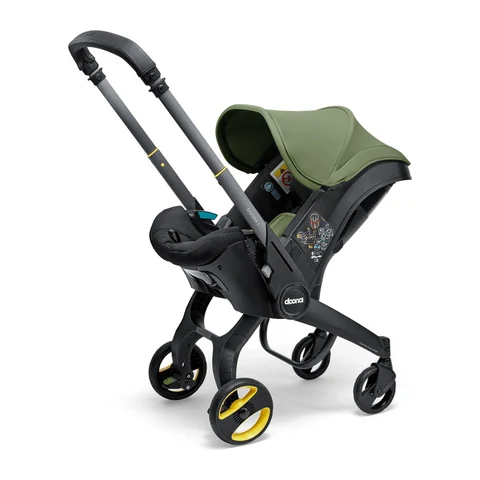 Stroller mode
One product in two states. In the car it is a rear-facing infant car seat like any other, certified to the European i-Size standard, ECE R129. Out of the car you pull a lever, a set of wheels swings down from underneath the shell, and it stands up as a stroller. There is no separate frame to carry, no chassis in the boot, no clicking a capsule onto a pushchair. The wheels were always there, folded into the base of the seat.
Stroller mode
One product in two states. In the car it is a rear-facing infant car seat like any other, certified to the European i-Size standard, ECE R129. Out of the car you pull a lever, a set of wheels swings down from underneath the shell, and it stands up as a stroller. There is no separate frame to carry, no chassis in the boot, no clicking a capsule onto a pushchair. The wheels were always there, folded into the base of the seat.
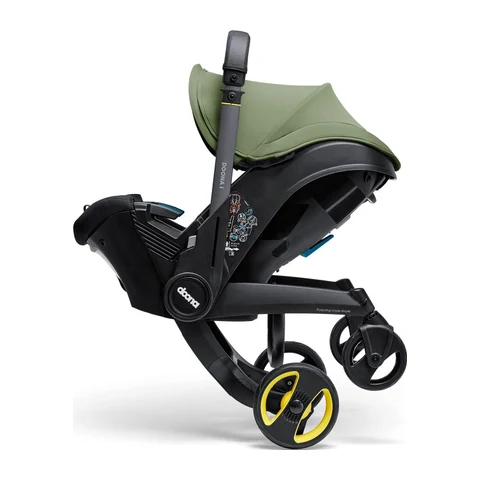 The fold, about one second
The fold is the whole product. Everything else about the Doona is ordinary. The seat is a competent infant seat, the canopy is adequate, the fabric is fine. What you are paying for is the transition, and the transition genuinely takes about a second in each direction, one-handed, while you are holding something else. In Hong Kong that second is the entire value proposition, because the alternative is a capsule you unclip, carry by the handle with your forearm burning, and then wrestle onto a frame you had to bring separately.
The fold, about one second
The fold is the whole product. Everything else about the Doona is ordinary. The seat is a competent infant seat, the canopy is adequate, the fabric is fine. What you are paying for is the transition, and the transition genuinely takes about a second in each direction, one-handed, while you are holding something else. In Hong Kong that second is the entire value proposition, because the alternative is a capsule you unclip, carry by the handle with your forearm burning, and then wrestle onto a frame you had to bring separately.
The Doona i sold in Hong Kong takes a child from 40 to 85 cm and up to 13 kg, weighs 8 kg on its own, and carries a two-year local warranty. It is rear-facing only, which is correct for this age group and not a limitation.
Why this matters more in Hong Kong since November 2025
On 1 November 2025 Hong Kong's child restraint rules changed. Under the Road Traffic (Safety Equipment) (Amendment) Regulation 2024, child passengers under eight years old must use a child restraining device in a private car, front seat or back, unless they have reached 1.35 m in height. Drivers who get it wrong face a fixed penalty of HK$230, rising to a maximum fine of HK$2,000 in serious cases.
If you own a car, this is no longer optional and a newborn needs a proper rear-facing infant seat from the first journey home. We break down exactly what is and is not required, and what parents make of it, in our guide to Hong Kong's child car seat law.
Taxis sit outside that regulation. The rules cover private cars, and taxis are not in scope, which is exactly the gap most Hong Kong families live in. Plenty of us do not own a car and take taxis several times a week. Legally you can hold a baby on your lap in a taxi. Physically, in a collision, that is the worst place a baby can be. This is where the Doona earns its keep for car-free families, and it is the single most Hong Kong-specific reason to consider one.
The first months: what it genuinely solves
The sleeping baby transfer
This is the one. A newborn falls asleep in the car, which they reliably do, and you arrive somewhere. With a conventional setup you unclip the capsule, carry it, unfold a frame, click the capsule on, and by then the baby has usually woken up. With the Doona you unclip, drop the wheels, and walk. The child does not change position, does not get lifted, does not get transferred between surfaces. They stay asleep.
If you have not done the alternative repeatedly, it is hard to convey how much difference this makes in the first three months. It is the difference between an outing that works and an outing that ends early.
Car to pavement in seconds
The same mechanism pays off in reverse and in every small moment in between. Arriving at a restaurant, a clinic, a friend's flat, a supermarket. There is no staging, no boot Tetris, no assembling anything on a wet kerb while a taxi waits behind you. You lift, you roll, you go.
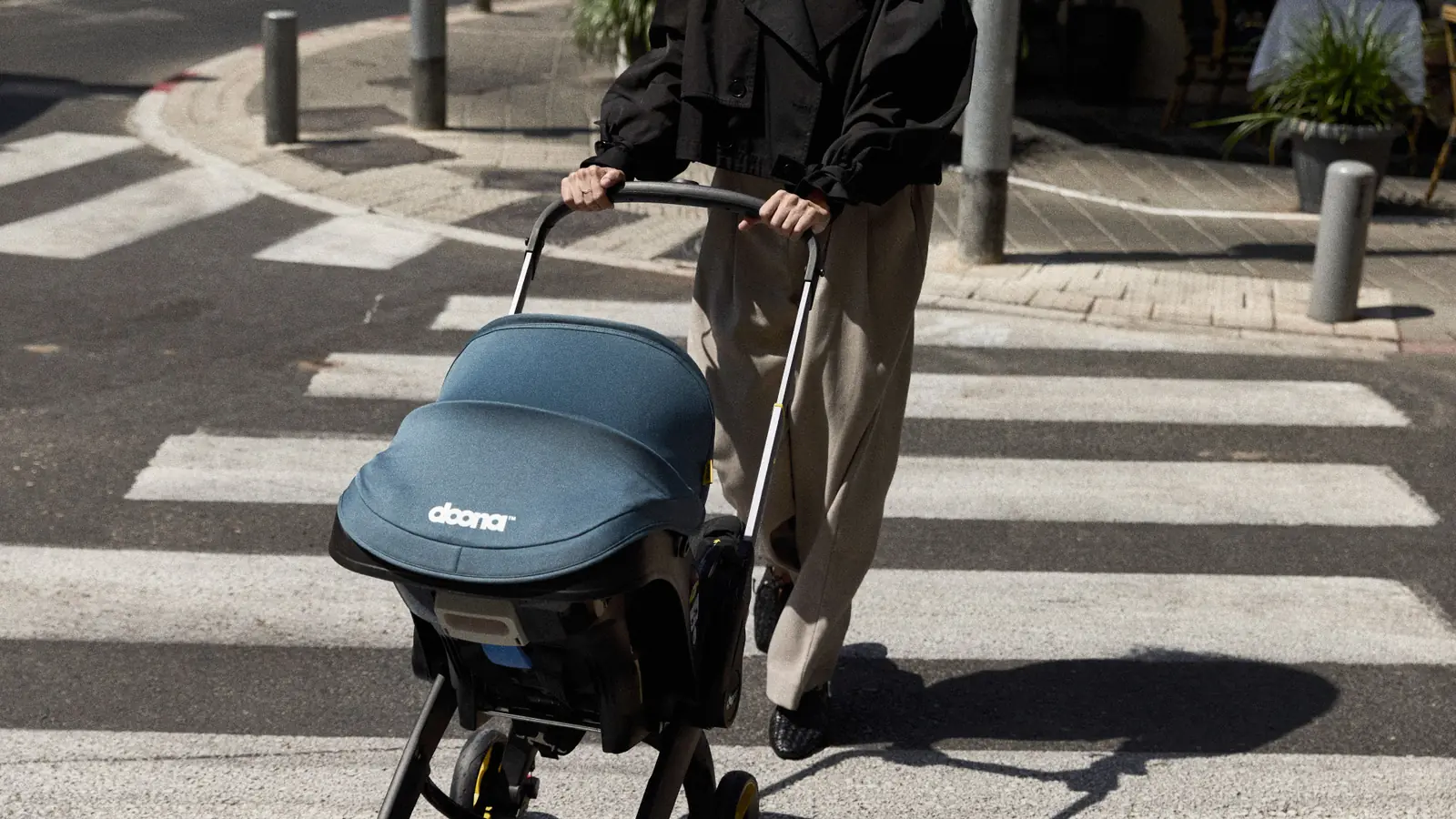
Taxis, and why base-free installation matters
The Doona installs with an ordinary three-point vehicle seat belt, with no base required. Doona publishes the belt routing for this and it is worth learning properly from the manual rather than improvising, because the European routing uses a lock-off and the American routing uses only the lap portion. Get the right one for your seat and check that it does not move more than about an inch at the belt path.
For a Hong Kong family without a car, this is the deciding feature. It means one object goes into the taxi with you, buckles in, and rolls away at the other end. No base to carry, no frame to bring.
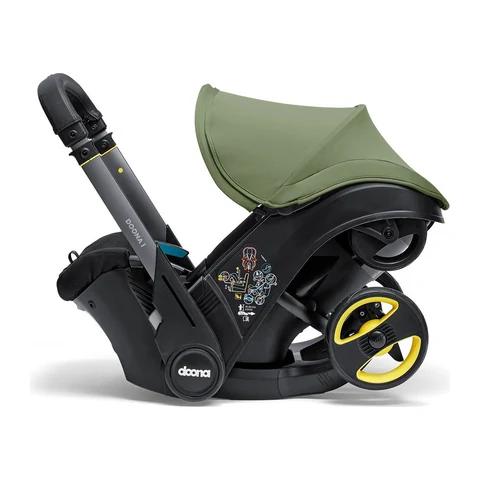 Car seat mode
Small flats forgive it. With the wheels tucked, the Doona is roughly the footprint of a normal infant car seat. It stands in a corner or behind a door. Given that the average Hong Kong flat has nowhere to park a stroller, a system where the stroller is the car seat means one object in your hallway rather than two, which is a real daily benefit and not a marketing line.
Car seat mode
Small flats forgive it. With the wheels tucked, the Doona is roughly the footprint of a normal infant car seat. It stands in a corner or behind a door. Given that the average Hong Kong flat has nowhere to park a stroller, a system where the stroller is the car seat means one object in your hallway rather than two, which is a real daily benefit and not a marketing line.
The ISOFIX base is worth it if you drive
The base is sold separately at about HK$1,380. It weighs 6.4 kg, clicks into your car's ISOFIX anchors, has a height-adjustable support leg and colour indicators that confirm the seat is properly seated.
We used the base, and it changed the experience. Without it, every trip means routing a seat belt correctly and checking the tension. With it, loading is a single click and unloading is a single release, and the colour indicator removes the doubt. If you drive regularly and move your child in and out of the car several times a day, the base is close to a no-brainer: it converts the slowest part of the process into a one-second action, which is the same trade the Doona itself is making.
If you do not own a car, skip it. It is dead weight you would never fit, and the seat-belt installation is what you want in a taxi anyway. Some families with one car buy a single base for their own vehicle and use the belt method everywhere else, which is the sensible middle path.
The heat problem nobody warns you about
Here is the drawback we actually experienced, and it is not on any spec sheet.
Babies get hot in the Doona in the car. The shell is deep, the padding is generous, the child is strapped in with their back against a solid surface, and Hong Kong is Hong Kong from May to September. On a warm day you can put a baby in perfectly comfortable and take them out flushed and damp.
This matters more than it sounds, because newborns are genuinely bad at regulating their own temperature. They cannot shed layers, they cannot tell you, and they lose and gain heat faster than adults do relative to their size.
What to do about it:
- Run the air conditioning with the newborn in mind, not the adults. What feels merely pleasant in the front is often too warm in a deep rear-facing shell.
- Make sure air is actually moving to the back of the cabin. Rear vents open, and do not let luggage block the airflow behind the front seats.
- Dress them for the seat, not for the walk. One fewer layer than you think, and skip the thick padded liners and footmuffs that look cosy in a shop.
- Check the back of their neck when you arrive, not their hands. Hands run cool on babies and will mislead you.
There is a second reason not to let the Doona become a default nap pod. Infant car seats hold a baby semi-reclined rather than flat, and prolonged time in that position is not ideal for a very young airway. The widely used guidance is a maximum of about two hours at a stretch for babies over a month old, and considerably less for newborns and pre-term babies. One study of infants in car seats measured average blood oxygen saturation falling from 97% to 94% after an hour, dropping to 90% in some cases.
None of this makes the Doona unsafe. It makes it a car seat, and every car seat carries the same caveat. But because the Doona rolls, it is unusually easy to leave a baby in it for a two-hour outing without noticing. Take them out at the other end.
Where it stops working: the eight to ten month wall
The published limits are 85 cm and 13 kg. Most families stop well before that, and we did too.
The carry weight stops making sense. The Doona is 8 kg empty. Add an eight-month-old at 8 or 9 kg and you are lifting 17 kg by a handle every time you meet a step, a kerb or a taxi boot. A conventional lightweight stroller weighs 6 kg and you never carry the child in it.
They want to sit up. From about six months a baby wants to see the world. The Doona is rear-facing and semi-reclined by design, so your child spends the outing looking at the sky and at you rather than at the city. That is right for a newborn and increasingly wrong for a nine-month-old.
There is no basket. None. You carry everything, and with a baby that means a changing bag on your shoulder for the entire outing.
It is not a walking stroller. The wheels are small and the ride is firm. It is fine across a car park and unpleasant across an hour of Hong Kong paving, tram tracks and slopes. For our guide to what actually survives the MTR, the hills and a small flat, the Doona does not make the list, and that is not a criticism. It is not trying to be that.
What to move to next
Around eight to ten months, split the job back into two products.
A car seat that stays in the car. A rear-facing seat for the next stage, left installed, never carried. If you own a car this is the point where a heavier, better seat becomes the obvious choice, because weight stops mattering once you are not lifting it. Our guide to choosing a car seat in Hong Kong covers what to look for and how the November 2025 rules apply as your child grows.
A lightweight travel stroller that stays with you. Around 6 to 7 kg, a genuine one-hand fold, narrow enough for an MTR wide gate, with a deep UPF canopy for the summer. Our best strollers for Hong Kong guide goes through the models that work here and why the fold matters more than anything else.
The two-product setup is more stuff to own. It is also lighter to carry, easier on the MTR and better for a child who now wants to look forward.
The money: new, base, or used on Carousell
New, the seat is about HK$3,480 and the ISOFIX base about HK$1,380, so a full setup lands near HK$4,860. That is real money for eight to ten months of use, and it is the honest objection to the Doona.
Two things soften it. First, the Doona holds its value unusually well, so when you move to a separate car seat and stroller you can sell it on and recover a meaningful share. Second, you can buy in the other direction: Carousell in Hong Kong regularly has Doonas at a fraction of retail, often barely used, precisely because every family before you also outgrew it at eight months.
If you buy used, treat a car seat differently from a cot or a high chair. It is a crash-protection device and it has a history you cannot see. Before you hand over money:
- Ask directly whether it has ever been in a collision, including a minor one. Impact damage is often invisible and a seat that has been in a crash should be retired. If the seller is vague, walk away.
- Check the expiry. A Doona expires six years from the date of manufacture, not from the date it was bought. The label is on the shell. A seat made in 2021 is close to done.
- Check for recalls against the model and manufacture date before you buy.
- Confirm every original part is there, including the infant insert and the manual, and inspect the harness webbing for fraying or stretching.
If the seller is a friend or family member who can vouch for the whole history, a used Doona is a genuinely smart buy. From a stranger who cannot answer question one, it is not worth the saving.
See it in action
Two things are worth watching before you decide, because both are the sort of thing that sounds fiddly written down and turns out to be trivial in the hand.
On the left, opening it out of the box: pull the handle up, press the release, and the wheels drop into place. On the right is the move you will make several times a day if you drive. Wheel it to the car, fold the wheels under, lower it onto the ISOFIX base until it clicks, and check the indicator has gone green. That whole sequence takes about as long as it takes to read this sentence, and it is the reason the base is worth the extra HK$1,380 if you are in and out of a car regularly.
If you are installing with a seat belt instead, the movement is the same up to the point the wheels fold. From there, follow the belt path in your manual rather than the clip.
Who should buy it in Hong Kong, and who should not
Buy one if you drive regularly, or you take taxis several times a week, and you have a newborn. If your baby routinely falls asleep in transit, the Doona will change your first six months more than any other purchase at this price.
Buy one if you fly with a small baby. It is TÜV aircraft approved and it goes down the aisle, which removes an entire category of airport misery.
Think twice if you walk almost everywhere and rarely get into a car. The Doona is a poor walking stroller and you would be paying a premium for a transition you rarely make. A lightweight travel stroller and a soft carrier will serve you better.
Do not buy one as your only stroller for the first two years. It cannot do it, and planning around that from the start is cheaper than discovering it at month nine.
The bottom line
The Doona is a specialist tool that is excellent at one thing and mediocre at everything else, and it is priced as though it were excellent at everything. Judge it on the one thing. For a Hong Kong family moving a newborn between cars, taxis and pavements, going from strapped-in to rolling in one second without waking the baby is worth a great deal, and no other product does it.
Buy it for the newborn months, add the ISOFIX base if you drive, watch the cabin temperature in summer, do not let it become the place your baby sleeps for hours, and plan your exit at around eight months rather than stretching it to the printed limit. Then sell it on to the next family, who will be just as glad of it as you were.
Once you have the transport sorted, the city opens up. Start with our guide to family-friendly things to do around Hong Kong, find a shady playground for the afternoon, and check what is on in our events listings to plan the weekend.