Hong Kong Child Car Seat Law 2026: Rules, Fines, Exemptions
Under 8 or under 1.35 m means a car seat, front or back, HK$230 if you get it wrong. But taxis are exempt and taxis crash 15 times more often. A plain-English guide to the rules and the argument around them.
Since 1 November 2025, any child under 8 years old riding in a private car in Hong Kong must use a child restraining device, in the front seat or the back, unless they have already reached 1.35 metres in height. The driver, not the parent, gets the HK$230 ticket. Taxis, buses and minibuses are not covered. Ride-hailing cars are.
That is the whole law in one paragraph. What follows is the detail parents actually ask about, the reasoning the government gave, and the argument that has followed it, because a lot of Hong Kong families think the rule stops in a strange place.
What the law says
The requirement comes from the Road Traffic (Safety Equipment) (Amendment) Regulation 2024, passed by the Legislative Council and brought into effect on 1 November 2025.
The rule. Child passengers aged below 8 must use a child restraining device in a private car, irrespective of whether they sit in the front or the rear seats, unless they have reached a body height of 1.35 metres. Passengers aged 8 or above, or with a body height of at least 1.35 m, must either use a child restraining device or wear an adult seat belt.
Note how that is written. It is under 8 years old AND under 1.35 m. A tall six-year-old who has passed 1.35 m is no longer required to use a restraint. A small nine-year-old is past the age threshold regardless of height. In practice almost every child under 8 in Hong Kong is under 1.35 m, so for most families the rule reads simply as "under 8, use a seat".
Who is liable. The driver. If a grandparent, a helper or a friend is driving your child, they are the one who receives the fixed penalty notice. Worth mentioning to them.
Which vehicles are covered
This is where most of the confusion sits, so here it is plainly.
| Vehicle | Child restraint required? |
|---|---|
| Private car | Yes, for under-8s below 1.35 m, front and rear |
| Ride-hailing car (Uber and similar) | Yes, these are private cars |
| Private light bus, goods vehicle | Front seat passenger aged 2 or under must use one |
| Taxi | No |
| Franchised bus, public light bus | No |
Taxis and public transport are outside the regulation and are not required to provide restraints. This is the part of the law that generates the most argument, and we come back to it below.
The two exemptions
The amended regulation provides exactly two statutory defences:
- The driver had reasonable grounds to believe the passenger had reached 8 years of age or a body height of 1.35 m.
- The driver was carrying a child in an emergency and had no time to arrange and use a restraining device.
There is no general exemption for short journeys, for a child who dislikes the seat, or for a car that happens to be full.
What counts as an approved device
A child restraining device has to meet a recognised safety standard. The Transport Department accepts a long list, and it is broader than most parents expect:
- UN Regulation No. 129 (i-Size, in force since 2013) and ECE Regulation No. 44
- ECE Regulation No. 16
- British Standards including BS 3254 and the BS AU series
- Australian and New Zealand standards AS 1754, NZS 5411 and AS/NZS 1754
- US Federal Motor Vehicle Safety Standard No. 213
- Japanese Industrial Standard JIS D0401
- EU Directive 77/541/EEC
- China National Standard GB 27887-2011
If you are buying new, R129 (i-Size) is the current European standard and the one to look for. It classifies seats by the child's height rather than weight, and it requires rear-facing travel until at least 15 months.
The Transport Department's own selection advice is worth quoting because it contradicts how most people shop: "When choosing CRDs, you should first select it based on the height and/or weight range for which the product is suitable, and use age as a reference only."
The three stages, in plain terms
Car seats are sold in a confusing overlap of age ranges. In practice a Hong Kong child passes through three of them.
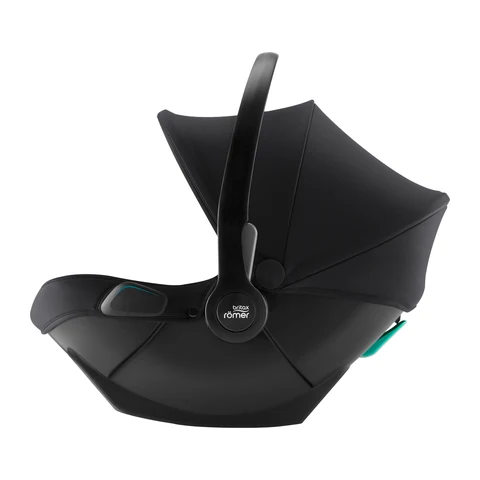 Stage 1. Rear-facing infant carrier, roughly 40 to 83 cm.
Stage 1. The rear-facing infant carrier, roughly 40 to 83 cm, birth to somewhere between 12 and 18 months. It lifts out of the car with the baby in it, which is the whole point at this age. It is always rear-facing, and it is the stage where a badly fitted seat does the most damage, because a newborn's neck cannot take a frontal impact in a forward-facing position.
Stage 1. Rear-facing infant carrier, roughly 40 to 83 cm.
Stage 1. The rear-facing infant carrier, roughly 40 to 83 cm, birth to somewhere between 12 and 18 months. It lifts out of the car with the baby in it, which is the whole point at this age. It is always rear-facing, and it is the stage where a badly fitted seat does the most damage, because a newborn's neck cannot take a frontal impact in a forward-facing position.
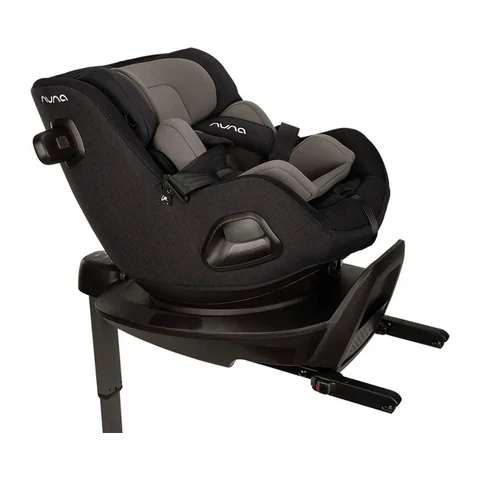 Stage 2. Toddler seat with a harness, roughly to 105 cm.
Stage 2. The toddler seat with a built-in harness, usually to around 105 cm or four years. Many now rotate, which lets you turn the seat towards the door to load a child and turn it back to face the rear. In a Hong Kong parking bay where the door opens halfway, that is a practical feature rather than a luxury. Keep the child rear-facing as long as the seat allows.
Stage 2. Toddler seat with a harness, roughly to 105 cm.
Stage 2. The toddler seat with a built-in harness, usually to around 105 cm or four years. Many now rotate, which lets you turn the seat towards the door to load a child and turn it back to face the rear. In a Hong Kong parking bay where the door opens halfway, that is a practical feature rather than a luxury. Keep the child rear-facing as long as the seat allows.
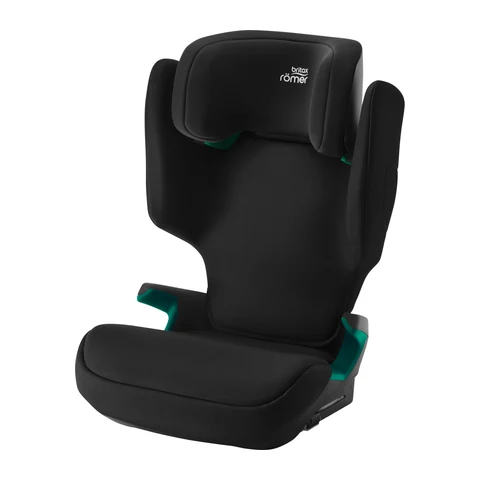 Stage 3. High-back booster, roughly 100 to 150 cm.
Stage 3. The high-back booster, roughly 100 to 150 cm. This one does not restrain the child itself. It raises them so the car's own adult belt crosses the shoulder and the hips rather than the neck and stomach, and the wings protect the head in a side impact. This is the stage families cut short, usually years early, because a six-year-old complains it is babyish. The height thresholds exist because an adult belt on a small body concentrates crash forces on the abdomen.
Stage 3. High-back booster, roughly 100 to 150 cm.
Stage 3. The high-back booster, roughly 100 to 150 cm. This one does not restrain the child itself. It raises them so the car's own adult belt crosses the shoulder and the hips rather than the neck and stomach, and the wings protect the head in a side impact. This is the stage families cut short, usually years early, because a six-year-old complains it is babyish. The height thresholds exist because an adult belt on a small body concentrates crash forces on the abdomen.
How to check a seat is actually legal
You do not need to memorise the standards list. Every compliant seat carries an approval label, usually an orange sticker on the shell or the base, and it tells you three things.
The standard. Look for R129 or ECE R44. R129 is the newer standard and is what almost every seat currently on sale in Hong Kong will carry. If a seat carries neither, and no other approved marking from the list above, do not buy it.
The size range. An R129 label states a height range in centimetres, for example 40-83 cm. This is the number that matters, not the age on the box. Measure your child.
The approval number. It begins with the country code of the authority that approved it. This is what confirms the label is a real approval rather than decoration.
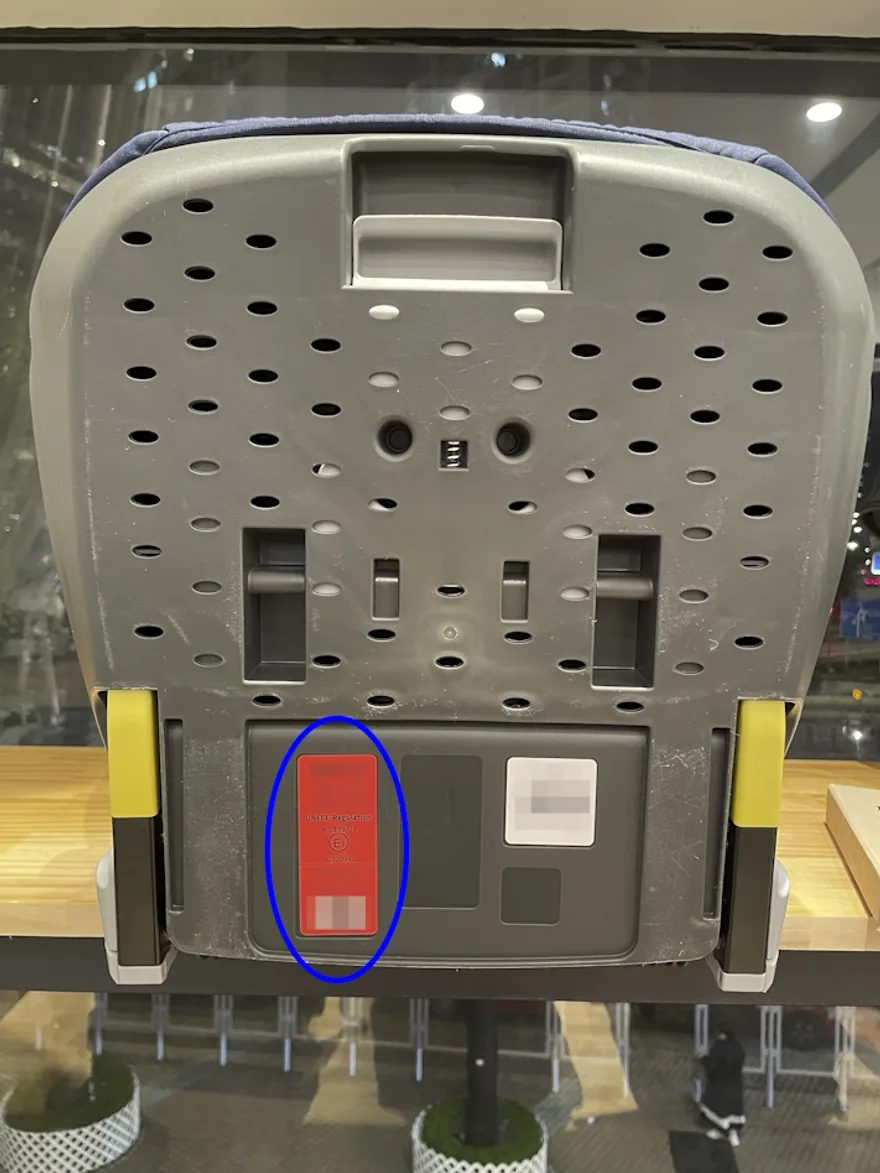 Where the approval label sits
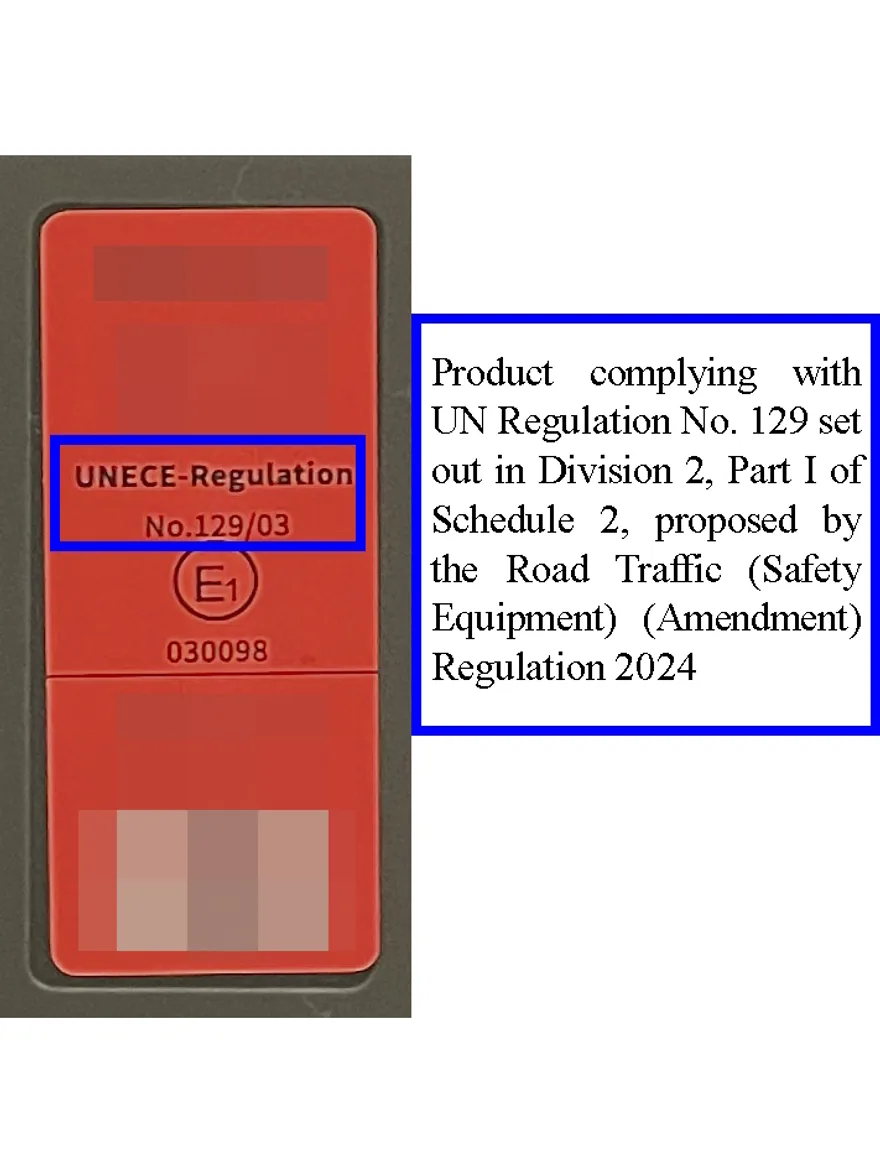 What an R129 approval looks like
The Transport Department's own example, above. The label is usually on the back or underside of the shell, and the marking to look for reads UNECE-Regulation No.129/03 with an E number in a circle. A product carrying that mark complies with UN Regulation No. 129 as set out in the Road Traffic (Safety Equipment) (Amendment) Regulation 2024.
A seat bought overseas is not automatically a problem, provided it carries one of the accepted standards. A seat bought from an unbranded online seller with no approval label is a problem, whatever the listing claims.
When to move to the next stage
The single most common error is moving a child up too early, usually because the current seat looks small or the child asks. Every stage change is a downgrade in protection, so the rule is to delay each one as long as the seat allows.
- Stage 1 to stage 2 when the child exceeds the carrier's height limit or their head reaches the top of the shell, typically 12 to 18 months. Not when they seem heavy to carry.
- Stage 2 to stage 3 when they outgrow the harness height, usually around 4 years and 105 cm. A harness spreads crash force across the shoulders and hips. An adult belt does not, which is why the booster comes later rather than sooner.
- Out of a booster at 150 cm, or when the adult belt sits flat across the middle of the shoulder and low on the hips without the booster. The law lets you stop at 1.35 m. Most seats are approved to 150 cm, and there is no reason to stop at the legal minimum.
The portable devices the law also accepts
This is the part most parents miss, and it is the part that matters most in a city where half the journeys are in someone else's car.
Alongside conventional seats, the regulation accepts portable child restraining devices. The Transport Department illustrates three of them on its own website, and these photographs are the government's, not ours.
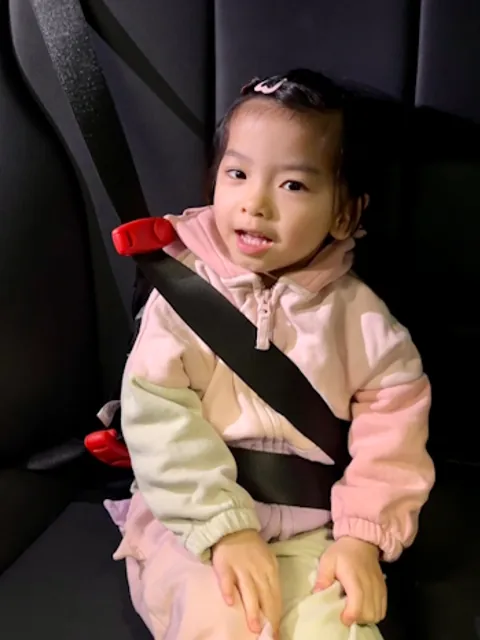 Seat belt adjuster
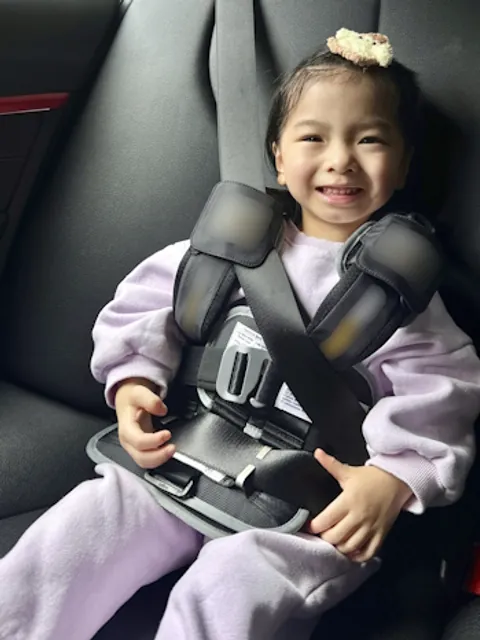 Wearable safety restraint vest
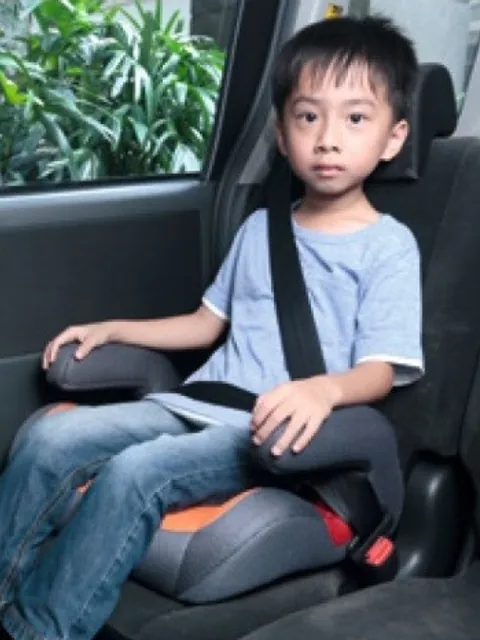 Foldable booster
The seat belt adjuster (left) pulls the adult belt down and in so the diagonal crosses the shoulder rather than the neck, and the lap section sits on the hips rather than the stomach. It is the smallest and cheapest of the three.
The wearable safety restraint vest (centre) is the one worth knowing about. The child wears it like a harness, and the car's own three-point belt threads through guides on the vest, which holds the belt in the right place across the collarbone and pelvis. It folds into a bag, weighs a fraction of a booster, and can be put on a child in a few seconds in the back of a taxi. The RideSafer Delight vest sold here costs around HK$1,709 and covers roughly 12 to 22 kg, or ages two to six.
The foldable booster (right) does the same job as a normal booster with a fraction of the bulk, though without a back it offers nothing in a side impact.
All three are legal restraints when they meet an approved standard. All three are also, in the Transport Department's own words, worse than a proper seat: portable devices "do not have protective pads and seat backs on both sides, generally speaking, the protection capabilities of such devices in side impacts are not as good".
So how should you think about them? Not as a cheaper alternative to a car seat, but as the thing you carry when a car seat is impossible. If you own a car, fit a proper seat and leave it there. If you are getting into a taxi, a vest in your bag is the difference between a restrained child and a child on your lap. That is a real safety gain in the vehicle category the law does not reach, and it costs less than most single car seats.
Why the government did this
Two numbers explain the timing.
The Transport Department reported that the proportion of traffic accidents involving children under 8 that occurred in private vehicles rose from 43% in 2021 to around 60% in 2024. Officials also stated that child restraining devices reduce casualty risk by around 70% in head-on collisions.
Hong Kong was also a late adopter. Officials noted comparable requirements already in place in Shanghai, Shenzhen, the European Union, Japan and Singapore.
What parents actually think
The rule has broad support in principle and a lot of frustration in the details. Three themes come up repeatedly in local coverage and parent discussion.
The cost stacks up. One seat per child, replaced as they grow, until age eight. Parents of two or three children are looking at a multiple of that. The Consumer Council's 2025 test found perfectly good seats from HK$2,380, but the sticker shock is real, and one parent quoted in local press described the rule as "有一點辣", a bit harsh.
Nobody is quite sure what to do without a car. A recurring worry is being unable to travel with a child at all in a hired vehicle. As one parent put it, "日後我帶住小朋友就唔可以call網約車", meaning they will not be able to call a ride-hailing car with their child. Uber responded by launching two child seat ride options from 1 November 2025, one carrying children aged 1 to 7 and one for 4 to 7, with a compliant restraint fitted. That helps, though availability and price are a different question from existence.
The taxi gap bothers people most. This is the criticism with real force behind it. Local reporting compared Transport Department accident rates and found 321 accidents per 1,000 taxis against 21.3 per 1,000 private cars, a roughly fifteenfold difference. Parents are now legally required to restrain a child in the safest vehicle category and legally free to hold that child on their lap in the one that crashes most.
The counter-argument from government and legislators is practical rather than principled. A taxi cannot know the age of its next passenger, cannot carry a seat for every size, and would need somewhere to store several. One lawmaker described regulating taxis as impractical for that reason, while suggesting that requirements might be attached to premium taxi fleet licences. A Transport Department engineer noted that around half of traffic injuries among under-8s occurred in private cars, with public transport accounting for a relatively low share.
Both things can be true. The rule targets where most child injuries happen, and it still leaves the highest-risk vehicle untouched.
And a quieter frustration: nobody teaches you to fit one. A car seat is the only piece of safety equipment most parents are legally required to own and never shown how to use. The Consumer Council found that four of the 22 seats it tested had installation procedures complex enough to raise the risk of getting it wrong. If a testing lab finds a seat fiddly, a tired parent in a car park at 7am will too. Several Hong Kong retailers now run fitting checks, and they are worth the trip.
The mistakes that actually matter
Some of these will get you a ticket. The rest will not, and are more dangerous.
Buying by age instead of height. The box says "0 to 4 years", your child is 3, and it still does not fit them. Height is the specification. Age is marketing.
Turning a child forward-facing too early. Legal at any age here. Still the wrong call, because in a frontal impact a rear-facing seat spreads the force across the whole shell instead of loading a small neck.
Bulky coats under the harness. Hong Kong winters are mild enough that this is a smaller problem than in Europe, but padded jackets compress in a crash and leave slack you cannot see when you tighten the straps. Strap first, blanket over the top.
A harness that is too loose. You should not be able to pinch a horizontal fold of webbing at the collarbone.
Leaving the seat loose in the car. Once fitted, the seat should not move more than about 2.5 cm at the belt path or ISOFIX anchors.
Fitting a seat in front of an active airbag. The law lets an under-8 sit in the front with a restraint. A rear-facing seat in front of a live passenger airbag is still dangerous. Deactivate the airbag or, better, use the back.
Keeping a seat after a crash. The Transport Department is unambiguous that a seat involved in a collision may look undamaged while its structure is compromised, and should not be used again. Most insurers will replace one as part of a claim, so ask.
What this means for you in practice
If you own a car, this is simple. Buy a seat that matches your child's height, fit it properly, and replace it at each stage. Our guide to the best car seats in Hong Kong works through the Consumer Council's crash test results, including the finding that the cheapest infant seat in the test scored joint best.
If you mostly take taxis, you are outside the law but not outside the physics. A light infant carrier that belts in without a base is the realistic option for the first year. From about age two, a wearable safety restraint vest is the honest answer: it lives in your bag, goes on in seconds, and is an approved restraint. It is not as good as a proper seat, and it is enormously better than a seat belt across a small child's neck.
If your baby is a newborn, the all-in-one car seat strollers are worth understanding, because they solve the taxi problem better than anything else and then stop being useful at around eight months. We go through the trade-offs in our Doona car seat stroller review.
Whatever you buy, do not buy it used from a stranger. The Transport Department is explicit that a seat involved in a collision may look undamaged while its structure is compromised, and should not be used again. You cannot verify that history from a marketplace listing.
And check your car before you check the price. ISOFIX anchor points are not universal, particularly in older vehicles and Japanese parallel imports, and not every ISOFIX seat fits every ISOFIX car. Manufacturers publish vehicle compatibility lists for this exact reason.
The bottom line
Under 8 and under 1.35 m means a proper seat, front or back, every journey in a private car, with a HK$230 ticket for the driver if you get it wrong. The two exemptions are narrow. The taxi gap is real and is not going away soon, so treat that as your own decision rather than the law's.
The part worth internalising is the Transport Department's own advice: buy by height, not by birthday, and fit it properly. A correctly installed mid-priced seat protects a child better than an expensive one fitted in a hurry.
Once that is sorted, go and use the city. Our guide to things to do with kids is a good place to start, or find a playground nearby and see what is on in our events listings.